
Explainer On Corporate Laws (Amendment) Bill, 2026
I. Introduction
The Corporate Laws (Amendment) Bill, 2026 (‘Bill’) was introduced in the Lok Sabha on 23rd March, 2026 by the Hon’ble Finance Minister, Smt. Nirmala Sitharaman. It proposes amendments to two central laws, namely the Companies Act, 2013 and the Limited Liability Partnership (LLP) Act, 2008.
The Bill draws its principal recommendations from the Company Law Committee (CLC) Report of March, 2022, and the High Level Committee on Non-Financial Regulatory Reforms (HLC-NFRR). It seeks to make Indian corporate regulation easier to comply with, harder to abuse, and better aligned with global standards, all in furtherance of the Government’s Viksit Bharat vision. The Bill has since been referred to a 31-member Joint Parliamentary Committee (JPC). The key amendments are briefly explained below.
II. Amendments Brought Through The Bill:
LLP Amendments: IFSC Framework
The Bill introduces a new category called ‘Specified IFSC LLP’ in IFSCs such as GIFT City. Such entities must have their registered office within the IFSC at all times, must carry the suffix ‘International Financial Services Centre LLP’ in their name, and are regulated exclusively by the International Financial Services Centres Authority (IFSCA).
Small Companies: Wider Definition, Lighter Compliance
The Bill expands the definition of a ‘small company’ under the Companies Act, 2013:
The ceiling on paid-up share capital is raised from ₹ 10 crore to ₹ 20 crore.
The ceiling on annual turnover is raised from ₹ 100 crore to ₹ 200 crore.
A larger number of companies will now qualify as small companies, thereby becoming eligible for a range of relaxations, including reduced monetary penalties at half the normal amount, a reduced board meeting requirement of just one meeting per year, and various other concessions.
Decriminalisation:
The most consequential aim of the Bill is the large-scale conversion of criminal offences into civil monetary penalties to save the law-abiding professionals from criminal liability for even minor procedural lapses. This change also helps decongest criminal courts and allows the enforcement machinery to focus on genuinely serious misconduct.
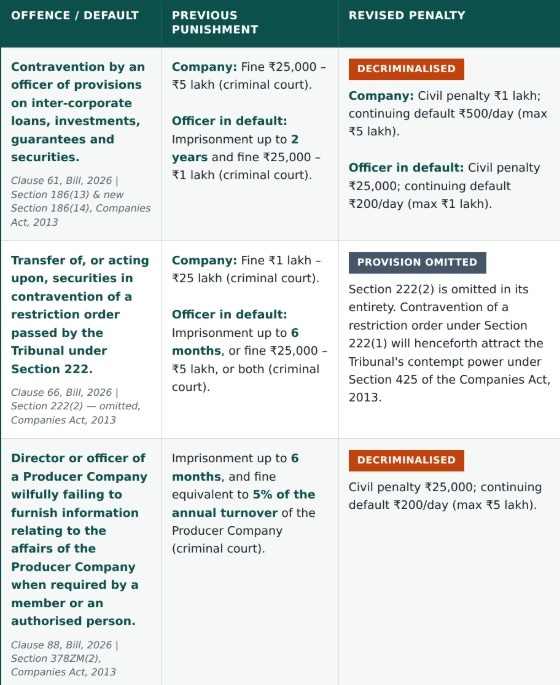
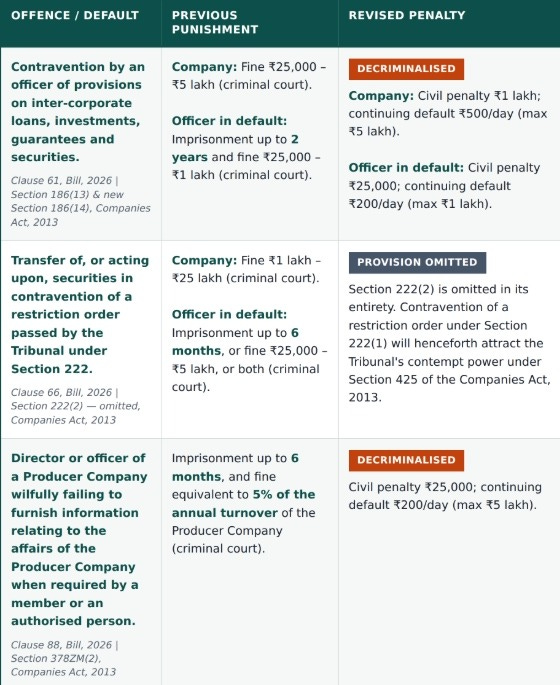
Image 1: Decriminalisation of Provisions under the Corporate Laws (Amendment) Bill. Civil penalties under the revised framework are to be adjudicated by an Adjudicating Officer under Section 454 of the Companies Act, 2013 and are not imposed by a criminal court. Appeals lie to the Regional Director or such Appellate Authority as may be notified, and thereafter to the NCLAT. A pre-deposit of 10% of the penalty amount is required before an appeal is entertained.
Buy-Back of Shares: Greater Flexibility
The existing legal framework permits companies to buy back their own shares no more than once in a twelve-month period. The Bill proposes that the prescribed classes of companies will be permitted to undertake up to two buy-back offers within a financial year, provided that the second offer is not initiated earlier than six months after the closure of the first. Also, such companies may also buy back shares beyond the existing ceiling of 25 percent of paid-up capital, up to a percentage to be notified through rules.
General Meetings: Virtual Participation Made Permanent:
The Bill enables companies to conduct Annual General Meetings (AGMs) and Extraordinary General Meetings (EGMs) through video conferencing or other audio-visual means, either fully or in a hybrid format. Every company must, however, hold at least one physical AGM within every three-year period. Also, where a requisite number of members as specified under Section 100 of the Act request a hybrid meeting, the company is obligated to accommodate that mode.
National Financial Reporting Authority (NFRA): A Significantly Empowered Regulator
One of the most substantial changes concerns the NFRA which is being transformed into a fully empowered statutory body with independent financial and regulatory capacity. NFRA is given the status of a body corporate, and a dedicated NFRA Fund is to be constituted, comprising Government grants, fees received from auditors, and other receipts. NFRA is empowered to issue directions to auditors and non-compliance with NFRA orders will attract penalties of up to ₹ 5 lakh for individual auditors and up to ₹ 25 lakh for audit firms, along with possible debarment.
Relaxed Corporate Social Responsibility (CSR) Norms
The Bill introduces several rationalisations to the Corporate Social Responsibility (CSR) framework. These changes will reduce compliance friction for mid-sized companies while preserving the integrity and intent of the CSR framework for larger enterprises.
Auditors: Stricter Independence, New Exemptions:
The Bill introduces both tighter restrictions on auditors and new exemptions for smaller companies, promoting Ease of Doing Business:
Small companies that meet prescribed conditions will be exempt from the mandatory requirement to appoint a statutory auditor.
Every partner of an audit firm, whether for financial, cost, or secretarial audit, must be registered with a statutory body such as the ICAI, ICAI-CMA, or ICSI.
Directors: Stronger Governance Standards
The Bill introduces several new disqualifications and tighter compliances for directors:
A person who has served as auditor, secretarial auditor, cost auditor, registered valuer, or insolvency professional of a company or its holding, subsidiary, or associate company during the preceding three financial years or the current financial year is not eligible for appointment as a director of that company.
All directors must now satisfy a ‘fit and proper’ criterion as assessed by the Board, with the criteria to be prescribed through rules.
The non-filing period that triggers directorial disqualification is reduced from three consecutive financial years to two, making the provision more stringent.
A clarificatory amendment has been inserted to make explicit that where a director incurs disqualification under that sub-section, the office of the director shall become vacant.
Mergers and Amalgamations: Streamlined Process:
The Bill introduces several rationalisations to the process of corporate restructuring:
All applications under the arrangement provisions will henceforth be filed with the NCLT bench having jurisdiction over the transferee or resultant company. That single bench will exercise all powers for all companies involved in the scheme, eliminating the current practice of approaching multiple benches.
For fast-track mergers, the creditor approval threshold is reduced from nine-tenths to three-fourths in value.
Demerger schemes are no longer required to be filed with the Official Liquidator, removing a procedural step that added delay without substantive purpose.
Insolvency and Bankruptcy Board of India (IBBI) as the Valuation Authority
The regulation of registered valuers, who conduct valuations of assets, shares, and property under the Companies Act, has hitherto been fragmented and loosely governed. The Bill addresses this comprehensively by designating the IBBI as the Valuation Authority.
Other Significant Changes
Several additional amendments of significance are worth noting:
Whole-time Key Managerial Personnel (KMPs) who are not directors now have a formal, statutory resignation process.
The President of the NCLT is empowered to constitute one or more special benches for the disposal of specific categories of cases under both the Companies Act and the Insolvency and Bankruptcy Code, 2016, allowing for specialised and faster adjudication.
The fraud penalty threshold has been increased. The minimum fraud penalty under Section 447 is raised from ₹ 10 lakh to ₹ 25 lakh, and the maximum from ₹ 50 lakh to ₹ 1 crore.
The Central Government is formally empowered to issue guidelines, circulars, and directions for the purpose of clarifying the intent of any rule or prescribing ancillary procedural requirements.
Annexure I - National Financial Reporting Authority: Important Details
I. Background
The National Financial Reporting Authority (NFRA) was constituted on 1st October, 2018 under sub-section (1) of Section 132 of the Companies Act, 2013, on the recommendation of the Standing Committee on Finance in the wake of the Satyam scandal. It was established as India’s first independent audit regulator, ending the long-standing self-regulation model under the oversight of Institute of Chartered Accountants of India (ICAI).
NFRA’s jurisdiction extends to listed companies, unlisted public companies meeting the threshold of paid-up capital of ₹500 crore, turnover of ₹1,000 crore, or aggregate outstanding loans, debentures and deposits of ₹ 500 crore, as well as insurance companies, banking companies, and electricity companies. The ICAI continues to regulate audits of private limited companies and smaller unlisted public companies falling below this threshold.
The statutory mandate of NFRA is fourfold:
to recommend accounting and auditing standards to the Central Government,
monitor and enforce compliance with such standards,
oversee the quality of service rendered by the auditing profession, and
perform such other ancillary functions as may be necessary.
Until the present amendment, NFRA functioned without a dedicated corpus, statutory body-corporate status, or express power to issue binding directions to auditors, leaving important enforcement gaps. The Corporate Laws (Amendment) Bill, 2026 closes these gaps by conferring body-corporate status, constituting the NFRA Fund, and giving the Authority explicit power to issue directions backed by graduated penalties. This amendment brings it on par with the Public Company Accounting Oversight Board (PCAOB) in the USA and the Financial Reporting Council (FRC) in the UK, as the comparison in the table that follows demonstrates.